 Corethix Module
Risk Register
Identify, record and mitigate risks in one central location. A configurable risk matrix with response plans, action tracking and real-time dashboards.
Risk Register
ActiveEverything you need to manage risks effectively
A comprehensive solution for risk identification, recording and mitigation
How to effectively identify, record and mitigate risks – best practices
Having a strong risk management framework is crucial for organizations to identify and evaluate potential risks, as well as develop effective strategies to minimize them.
A risk register is a useful tool to enable an organization to record all identified risks, define the likelihood and consequences of a risk occurring and to document actions being implemented to reduce the risks.
Corethix has been specifically designed to help any size organization proactively identify, record and mitigate risks.
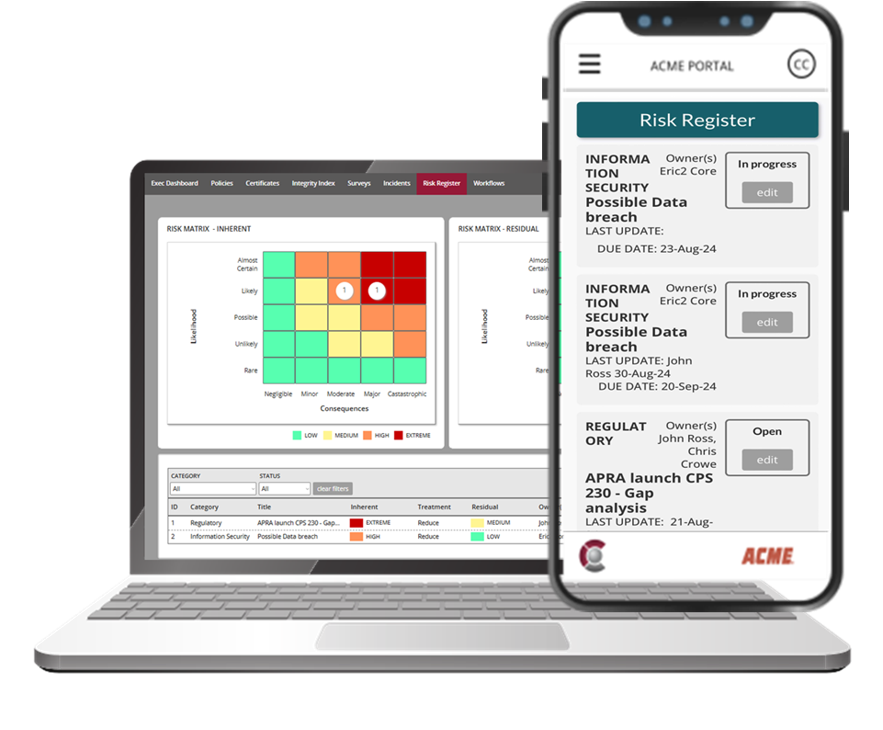
Configure risk matrix and risk levels
The first step in creating a risk register is to configure your organization's risk register matrix and define the elements of likelihood and consequences. This is followed by setting up the risk levels that can be selected for each risk register.
The Corethix risk register matrix can be easily configured in multiple matrix sizes and risk levels can be customized by range and color codes.
Define categories and treatment options
The next step is to define the risk register categories which will be assigned when adding new risk registers. This is followed by configuring treatment options that can be selected for each risk register.
- Unlimited risk register categories with alert notifications
- Configurable treatment options for each risk category
- Link risk registers to specific categories automatically
Add risk registers and response plans
Once the risk register categories are configured, then risk registers can be added and linked to a specific category. Risk controls and action plans to mitigate each risk can then be setup and assigned to specific team members.
- Link risk registers to specific categories
- Set up risk controls and mitigation action plans
- Assign actions to specific team members with due dates
Define inherent and residual risk
Each risk register needs to have an inherent and residual risk setting to define the consequences and likelihood of the risk occurring and the treatments that will be implemented to mitigate the risk.
- Easy to configure inherent and residual settings
- Visualize settings in the risk register dashboard
- Track risk reduction over time with treatment progress
Monitor risk register action plans
All risk register key controls and actions need to be defined and progress closely monitored to ensure risk mitigation actions are being implemented by the scheduled dates.
- Detailed dashboard with real-time status of all actions
- Track progress against scheduled implementation dates
- Proactive management and follow up on overdue actions
Send notifications and reminders
Once treatment options and associated actions have been created and assigned, it is critical to proactively monitor progress of actions and to follow-up where needed to ensure actions are implemented by the due dates.
- Automated alerts when actions are late in being implemented
- Reminders sent before action due dates
- Notifications to administrators requiring attention
Regular review and proactive management
The success of any program to identify, record and mitigate risks requires a regular review of the risk register to proactively ensure that risk treatments and action plans are being implemented and to identify any problem areas. This is best achieved by having an up to date and detailed risk register dashboard with analytics.
- Real-time dashboard with analytics for proactive management
- Up-to-date reporting and audit trail of historical data
- Identify problem areas before they escalate
Powerful features for risk management
Built for organizations that take risk management seriously
Configurable Risk Matrix
Easily configure your risk matrix in multiple sizes with customizable risk levels, color codes and ranges.
Risk Categories
Define unlimited risk register categories and configure treatment options with alert notifications for each category.
Response Plans
Add risk registers linked to categories with risk controls and action plans assigned to specific team members.
Inherent & Residual Risk
Configure inherent and residual risk settings for each register to define consequences and likelihood.
Automated Notifications
Continuously monitors progress and sends alerts when risk register actions are late in being implemented.
Real-time Dashboard
Detailed dashboard provides real-time display of risk matrix status and progress of response plans and actions.
Why organizations choose Corethix
Transform your risk management from a reactive process into a proactive strategic advantage.
Identify Risks Early
A simple and effective way of identifying risks in advance and taking steps to mitigate those risks.
Reduce Risk Exposure
Proactive monitoring ensures risk treatments and action plans are implemented on schedule.
Likelihood & Consequences
Define the likelihood and consequences of a risk occurring and document actions to reduce the risks.
Complete Visibility
Real-time view of inherent and residual risk status for each identified risk across your organization.
Risk Register FAQ
Common questions about risk management with Corethix